
As renewable penetration rises, the limiting factor in many grids is no longer generation. It is time and integration. We can generate vast amounts of low‑cost solar and wind, but we can’t yet move that energy across days or weeks with the precision and efficiency the system needs. That’s the role of long duration energy storage (LDES). Increasingly, it is also the role of DC‑coupled architectures and advanced DC recombiners that make these assets technically and economically viable.
At Shoals, we see this shift through the lens of electrical balance of system (EBOS): the DC-side infrastructure that helps solar, storage, and data centre power systems connect, aggregate, protect, and scale.
1. Why long‑duration storage is moving from “nice to have” to “non‑optional”
Three structural forces are pushing LDES from the margins into the core of system planning:
- Multi‑day renewable droughts (Dunkelflaute): Extended low‑wind/low‑solar events cannot be bridged by 2-4 hour batteries alone.
- Curtailment and congestion: High renewables regions are seeing growing spill and constrained export. LDES can absorb surplus energy and release it during stressed periods.
- Firming and system security: As synchronous generation retires, the grid needs multi‑hour to multi‑day firm capacity, not just fast frequency response.
LDES technologies like flow batteries, thermal storage, mechanical storage, and hybrid architectures are all trying to solve these gaps. But their success depends heavily on how they are integrated electrically, not just on their chemistry.
2. Why DC power and DC‑coupled BESS are becoming more important
Historically, most storage has been AC‑coupled: batteries connect on the AC side via dedicated inverters, often separate from solar or other generation. While this architecture allows flexibility, it also has drawbacks:
- Fewer conversions: Solar and other DC sources can charge storage directly on the DC bus, improving round‑trip efficiency.
- Reduced component count: Fewer inverters and transformers can lower capex, maintenance, and labour, when the project architecture supports it.
- Simpler augmentation: Additional battery capacity can be added on the DC side without proportionally increasing inverter count, provided the DC collection and protection system is designed for it.
- Better multi‑asset integration: Solar, short duration BESS, and LDES can share a common DC backbone, improving utilisation and enabling more sophisticated dispatch strategies.
For LDES, where durations are long and energy volumes large, these efficiency and capex advantages compound over time.
3. Data centres: the new driver of LDES demand
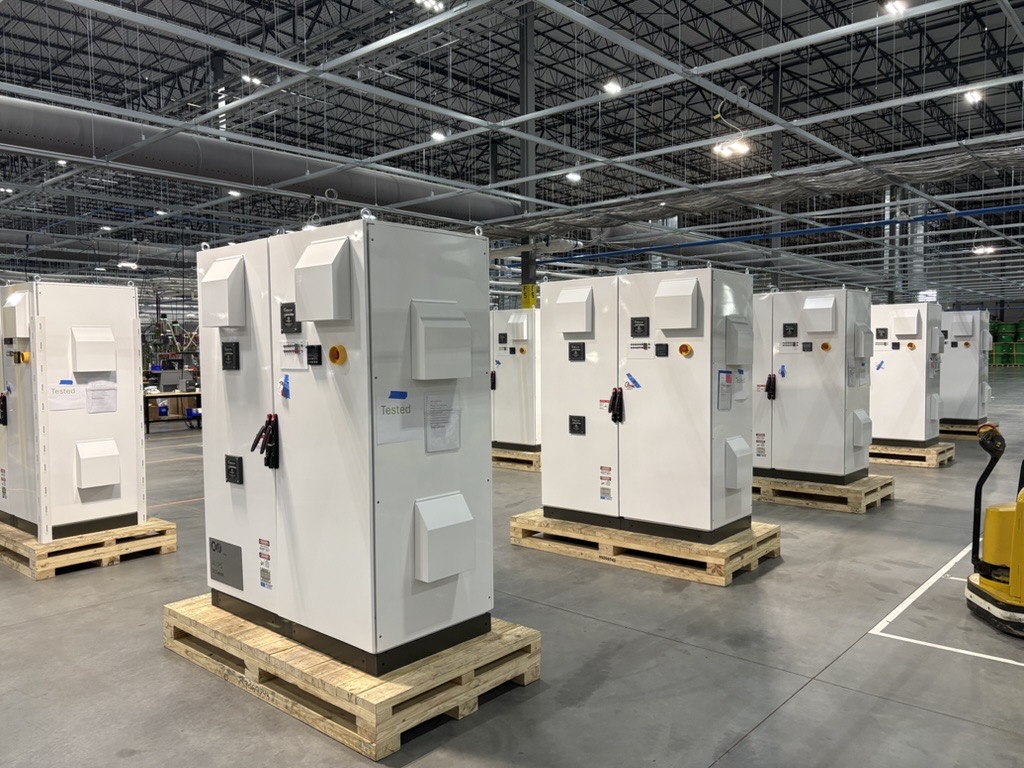
Data centres have become a major new demand on modern electrical grids. They rely on highly reliable, uninterruptible power, requiring extreme resilience and minimal outage risk, and expanding at a pace that often outstrips transmission infrastructure upgrades. Their rapid growth, driven by AI and cloud workloads, is intensifying pressure on grid capacity and long‑term system planning. Although the sector has traditionally depended on diesel backup and grid redundancy, this model is increasingly incompatible with decarbonisation goals, rising grid volatility, and the growing likelihood of multi‑hour outages.
Long duration energy storage offers a structurally better fit, delivering 10+ hours of firm capacity, multi‑day resilience without diesel, renewable shifting to enable 24/7 carbon‑free energy, and seamless integration into on‑site or near‑site microgrids. Short‑duration BESS continues to manage UPS‑style bridging, while LDES provides the extended resilience required beyond the first hour.
4. DC recombiners as the enabler for scalable, DC coupled storage
The shift to DC-coupled architectures is placing new demands on the electrical balance of system (EBOS), with higher continuous DC currents, rising short-circuit potential as battery blocks scale, multiple DC sources such as solar, BESS and LDES operating on a shared bus, and a growing need for safe, modular aggregation and protection.
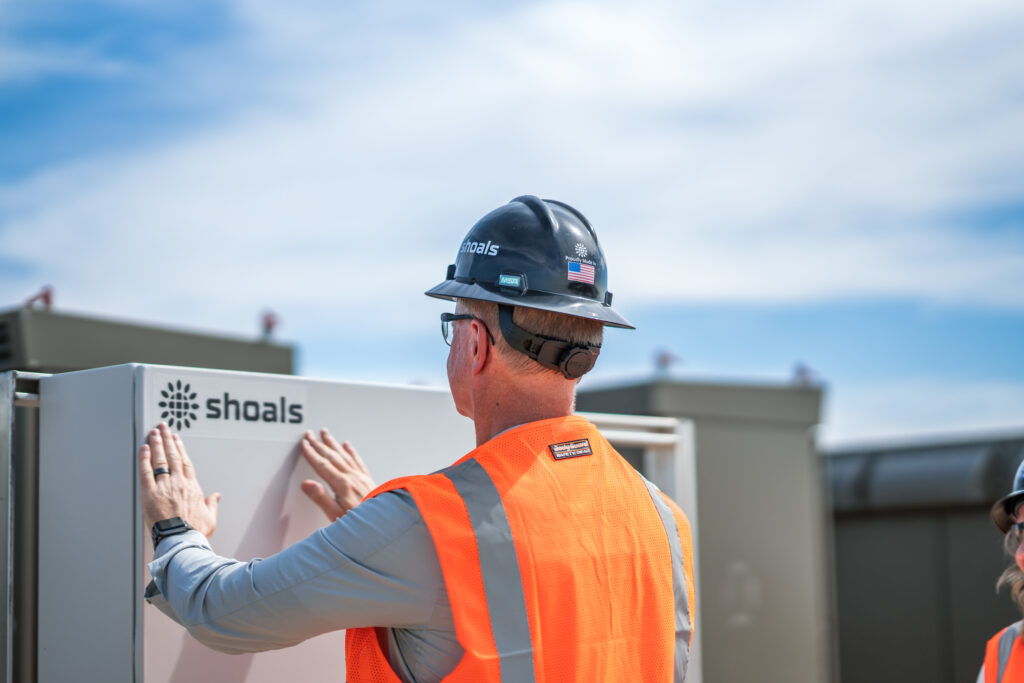
This is precisely where reliable DC recombiners from Shoals add the most value. A DC recombiner is engineered to collect and combine multiple DC inputs, such as several battery strings and solar arrays into larger DC feeders that connect to inverters or DC‑DC converters. Modern recombiners for BESS applications support 1,200–4,000 A ratings, offer up to 24 inputs, optional disconnects and contactor controls. They are built for utility‑scale voltages up to 1,500 VDC and are 2kV ready. Shoals is a well‑known manufacturer in this space, but the principle is industry‑wide. DC recombiners are the enabling hardware that make large‑scale, DC‑coupled storage architectures practical, safe, and bankable.
5. Battery augmentation simplified with DC Recombiners
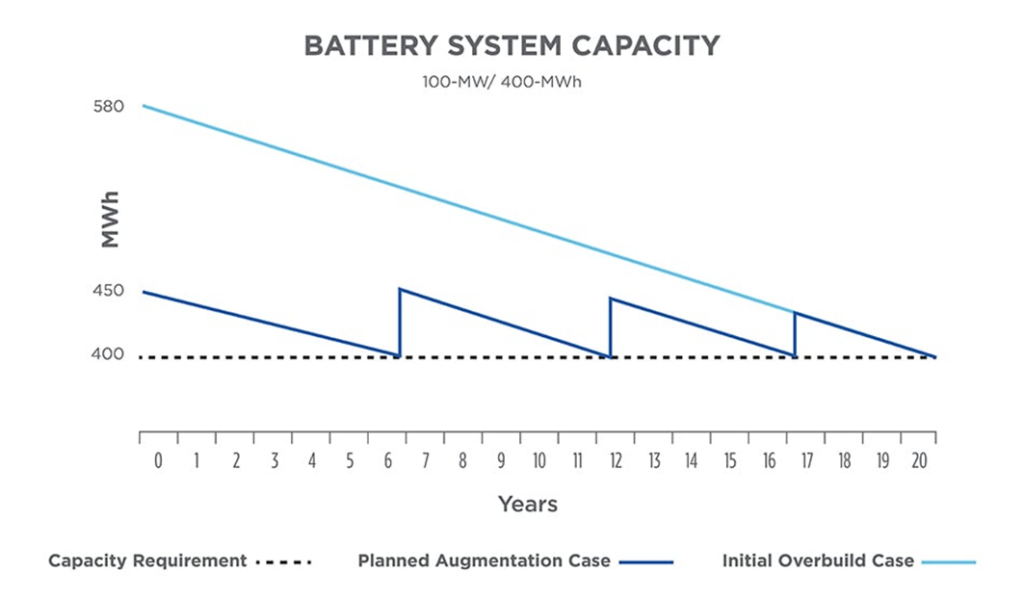
Battery augmentation is one of the most strategically important advantages of DC‑coupled architectures, given the inevitable need to add capacity over time. In an AC‑coupled design, augmentation typically requires adding more battery containers or modules, or increasing inverter capacity. This often triggers re‑engineering of AC protection, cabling, and sometimes transformers.
In a well‑designed DC‑coupled system, additional battery strings can instead be landed directly on the DC side, using existing or expanded recombiner capacity. Inverter capacity can remain fixed, provided it was originally sized with headroom and the DC bus and recombiners were designed for future current levels. This avoids the need to add new inverters at every augmentation step, reducing both capex and system complexity. The approach is particularly attractive for data centre microgrids. There, load growth is phased, predictable, and tightly linked to digital infrastructure expansion.
Source: Burns & McDonnell
6. Short circuit current and protection: the less glamorous, critical piece
Short‑circuit current and protection remain one of the least glamorous yet most critical aspects of DC‑coupled design. As battery blocks grow in size and more assets share a common DC bus, available fault current rises sharply. This is driven by larger battery strings, lower internal impedance, parallel DC sources such as PV, BESS and LDES, and the contribution of DC‑link capacitors during faults.
Modern DC recombiners are engineered to manage this environment by offering high short‑circuit current ratings (SCCR), integrating appropriately rated fusing, disconnects and contactor‑based controls, and enabling coordinated protection schemes across multiple DC sources. In long duration storage projects where total installed energy and prospective fault currents can be very high, this is not a minor detail. It becomes a gating factor for safe, insurable and financeable system design, ensuring that protection devices can interrupt DC faults, that fault energy is contained, and that the system meets utility‑scale safety and compliance requirements.
7. LDES investment lens: what to look for in DC side design
When evaluating LDES or hybrid solar‑plus‑storage projects, a technical investment review must look beyond nameplate capacity. It should consider the long‑term integrity of the electrical architecture. The first decision point is architectural: will the system be AC‑coupled, DC‑coupled, or hybrid? This choice determines efficiency, augmentation flexibility, protection requirements, and the project’s long‑term cost trajectory. From there, the robustness of the DC backbone becomes a central investment consideration.
Recombiners must be sized and rated not only for today’s current levels but for future augmentation, higher‑capacity battery blocks, and the integration of multiple DC assets over time. Short‑circuit current ratings (SCCR) and protection coordination must be explicitly engineered, particularly as LDES introduces very high stored energy and prospective fault currents that can exceed the interrupting capability of commodity hardware. A credible augmentation strategy is equally essential: can new battery strings be added on the DC side without triggering costly inverter, transformer, or AC protection upgrades?
Finally, the architecture must support multi‑asset integration, enabling short‑duration BESS and long‑duration storage to coexist on a shared DC bus without re‑engineering. Projects that meet these criteria consistently deliver higher round‑trip efficiency, lower lifecycle capex, smoother augmentation, better utilisation of renewable generation, and materially lower integration risk.
This is precisely why Shoals’ recombiner technology must be considered in any LDES or hybrid project evaluation. Shoals is not only a technical leader in high‑SCCR, modular, future‑proofed recombiner design, it is also one of the most reliable and bankable suppliers in the sector. With a decades‑long track record of delivering safe, high‑quality electrical balance‑of‑system solutions across more than 100 GW of global projects, Shoals provides the engineering assurance, manufacturing consistency, and compliance pedigree that investors, insurers, and EPCs rely on.
In DC‑coupled and hybrid architectures, the recombiner becomes the backbone of safe aggregation, scalable augmentation, and multi‑asset integration. Choosing a recombiner that is not engineered or proven for these demands can constrain project design, limit future expansion, and introduce avoidable risk.
8. Looking Ahead: The Next Era of Power Infrastructure
The next decade of energy and digital infrastructure won’t be defined by generation, but by architecture. LDES, data centre‑grade resilience, and DC‑coupled design are converging into a new operating model where efficiency, scalability, and protection discipline matter more than ever. The projects that succeed will be the ones built on DC systems that can grow, adapt, and host multiple storage technologies without redesigning the electrical backbone every time the system evolves.
In this future, the DC recombiner becomes the quiet enabler. It determines whether augmentation is simple or costly, whether protection schemes remain safe or become a liability, and whether multi‑asset DC systems can scale to meet the demands of AI‑era loads. As grids push toward 24/7 carbon‑free energy and data centres require multi‑hour resilience, the projects that endure will be those grounded in DC architectures built for what’s coming supported by reliable, bankable pioneers in DC system design who can future‑proof assets from day one.
Planning a solar + storage, LDES, or data centre power project?
Reach out to Shoals to talk about DC-side EBOS design and scalable power infrastructure for high-current, multi-asset systems. Learn more about Shoals Power Hub and Shoals Air Link, our solutions for the data centre market.