


The solar industry is moving fast. Projects are getting bigger, more complex, and more critical to the clean energy transition. But at the heart of every solar project are a few essential building blocks that make it all work.
This post is part of our Solar Speak series. Here, we’ll break down key components of a solar PV system, such as mounting structures, inverters, and the electrical balance of systems (EBOS). We’ll look at what they are, how they work, and why they matter. Whether you are new to solar or looking for a refresher, this guide will help you gain fluency in the fundamentals.
Mounting structures
When you see a solar project, the panels are the most visible feature. However, those panels must be held in place by a mounting structure. The two main options used are fixed mounting systems and tracker mounting systems.
Fixed Mounting Systems
Fixed mounting systems use tilted, stationary frames.
- Pros: Lower cost and simpler to install. Minimal maintenance compared to moving systems.
- Cons: Panels stay at one angle all day. They cannot maximize exposure as the sun moves, which limits the overall generation.
Because of these limits, developers and EPCs are rarely using fixed mounting systems in projects larger than 1 MW.

Fixed mounting system
Tracker Mounting Systems
Tracker systems are dynamic. Motors and hinges allow modules to follow the sun across the sky.
- Pros: More efficient, since the panels track the sun and generate more energy throughout the day.
- Cons: Higher costs, more space required, and additional maintenance. The motors and moving parts introduce complexity, including potential gaps in the array.
Developers and EPCs typically use trackers in larger projects above 1 MW, where the energy gains outweigh the added complexity.
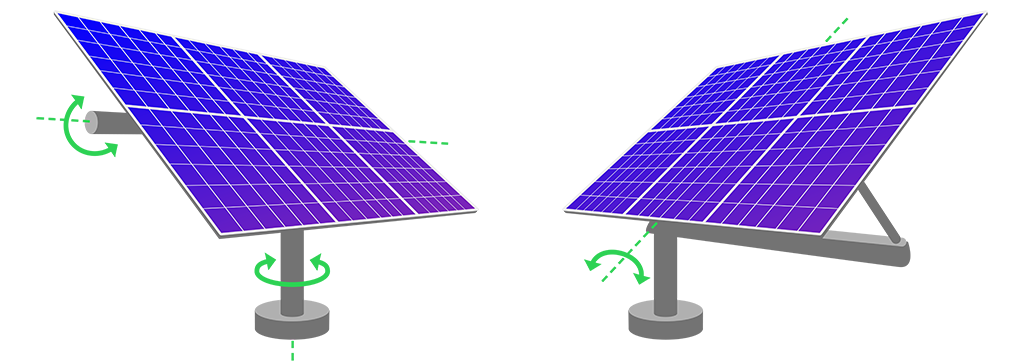
Solar trackers and how they rotate
Motor gaps
In tracker systems, motors are typically used to adjust the angle of the solar modules throughout the day. Some systems utilize a single larger motor with links to other rows and others have individual motors per row to have independently driven rows.
Regardless, in cases where a string of modules overlaps with the motor location, there is often a gap which is left to not have interference between the panels and motor assembly.
The distance of this gap can be too large to be spanned directly by the lead wires of the modules themselves and may require the use of jumper cables to cover the gap distance. While necessary, these extra components add design and installation considerations.
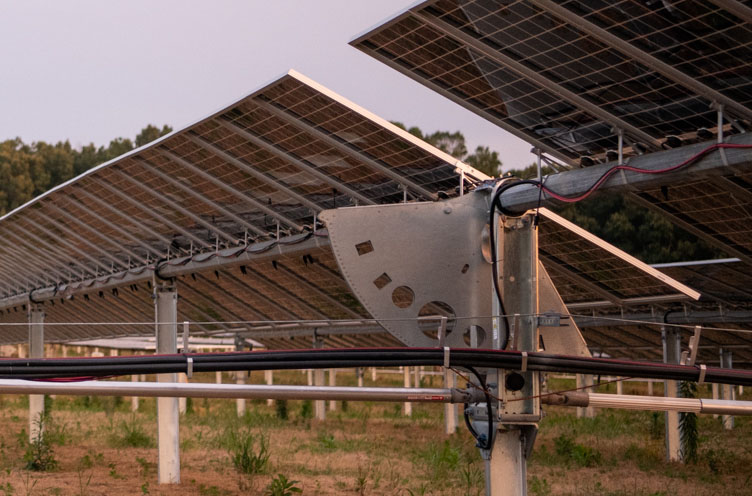
Motor gap at one of Shoals’ customer projects
Bearing housing assembly (BHA)
Gaps in the row may also be due to the presence of a Bearing Housing Assembly (BHA). A BHA is often present when a motor is in one location, but its motion is transferred along the length of the row.
Similar to motor gaps, if these BHAs overlap with a string of solar modules, there is a gap in the string which must be accommodated by additional jumper cables.
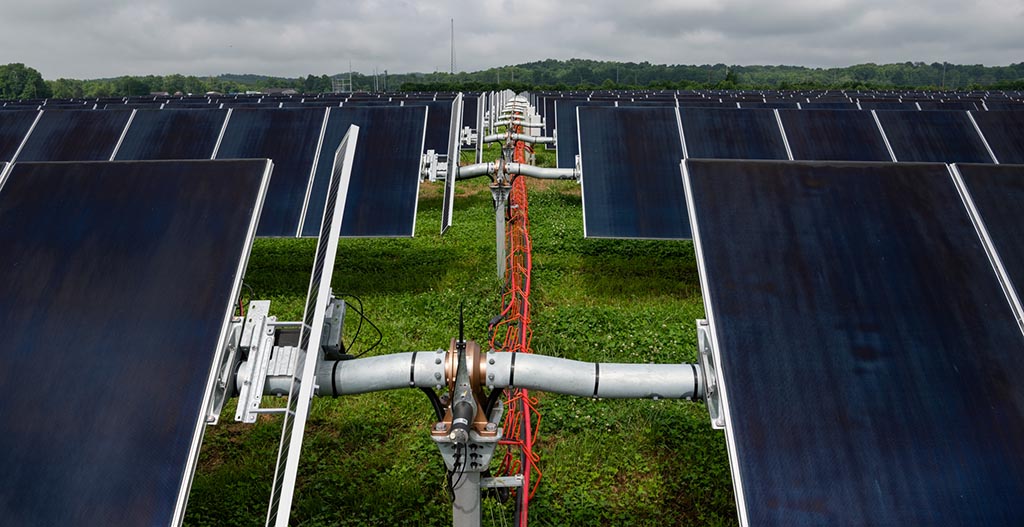
Bearing Housing Assembly (BHA) at one of Shoals’ customer projects
Inverters
Solar panels generate direct current (DC). The grid, however, uses alternating current (AC). This is where inverters come in. They perform the critical role of converting DC into AC so the electricity can be used, stored, or transmitted. Choosing between inverter types has significant implications for cost, efficiency, and operations.
Central Inverters
Central inverters are large units, often with an AC output of 4–4.5 MWac. They collect DC from a large block of modules. Central inverters typically output at medium voltage, which improves efficiency for long-distance transmission.
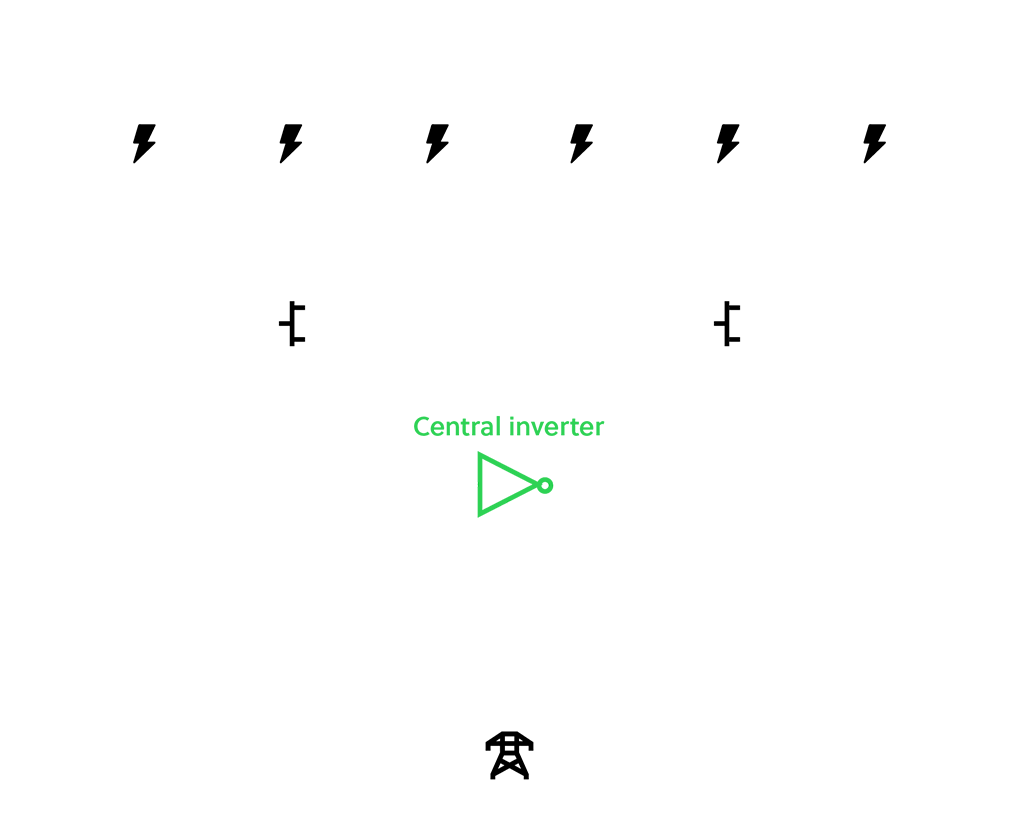
Central inverter layout
Pros:
- Fewer points of failure.
- Lower capital cost per watt.
- Compact footprint in a central location.
- Fewer service points, making operations easier.
Cons:
- Require highly skilled electricians for install, maintain, and repair.
- A single failure can take out a large section of a project, leading to revenue loss.
- Less flexible and less scalable.
Central inverters are common in large utility-scale projects where centralized control and efficiency are critical, but downtime risk must be carefully managed.
String Inverters
String inverters are smaller units, typically rated at 60 kWac or less for commercial projects and up to 300 kWac for community solar. They produce a low-voltage AC output, which is usually combined in a switchboard and then stepped up by a transformer to match grid requirements. To provide the same capacity as a 4.5 MWac central inverter, roughly 18 string inverters at 250 kWac each would be needed.
Pros:
- Easier to install and maintain, with a larger pool of qualified technicians.
- Failure of one inverter only affects a small part of the system, limiting potential downtime.
- Flexible and scalable, making them attractive for projects with varied site conditions.
Cons:
- More total points of failure.
- Higher capital cost when scaled.
- Decentralized across the site, which can complicate O&M logistics.
String inverters are often chosen for projects where modularity and resilience are more valuable than centralized efficiency.
Electrical balance of systems (EBOS)
While modules and inverters often take center stage, EBOS is what ties everything together. EBOS components include all the wiring and electrical equipment that safely deliver power to the grid or to a battery storage system.
Typical EBOS components include:
- Harnesses are wiring assemblies that collect power from one or more strings of solar modules into a single wire.
- Combiners are enclosures which merge several inputs into a single larger wire with a higher capacity. Combiners often have built-in DC disconnects.
- Fuses are a means of protecting each wire/string input from damage due to overcurrent or backfeed current.
- DC Disconnect Boxes allow technicians to interrupt the flow of current from a subsection of an installation in order to perform troubleshooting, repairs, and/or maintenance.
These pieces are vital for both system performance and safety. At Shoals, EBOS is an area of deep expertise, with components engineered for efficiency, reliability, and long-term operation.
Wiring solutions in photovoltaics (PV)
Wiring may seem straightforward, but in solar it’s specialized. A variety of different wire materials and sizes are used across the installation. Conductors must carry current efficiently while also withstanding environmental stress for decades. For example, wires must endure heat, moisture, UV light, and even chemical exposure depending on the project location.
- Materials: Copper, tinned copper, or aluminum, depending on cost and conductivity needs.
- Cores: Solid or stranded cores affect flexibility and durability.
- Insulation and Sheathing: Provides protection against heat, chemicals, moisture, and UV radiation.
- Common insulation materials: XLPE and XLPO, both durable thermosetting plastics formed through cross-linking.
The wrong choice in wiring can lead to failures, safety hazards, and costly downtime. As projects scale, optimized wiring design becomes critical for keeping costs and risks under control.
Solar connectors
Nearly all solar projects require connectors to electrically link site components. At a minimum, solar modules come with lead wires that are pre-terminated with PV connectors. These same connectors are also commonly used in factory-made wire harnesses to enable plug-and-play installation.
One of the most widely used PV connectors is the MC4, originally developed by Staubli. The name reflects its design: “MC” stands for “multi-contact,” and “4” indicates the 4 mm diameter contact pin.
Across the industry, the term “MC4” has become a generic reference for similar connectors made by other manufacturers. However, mixing and matching connectors from different manufacturers is a poor practice and is not recommended, as it can compromise safety and performance.
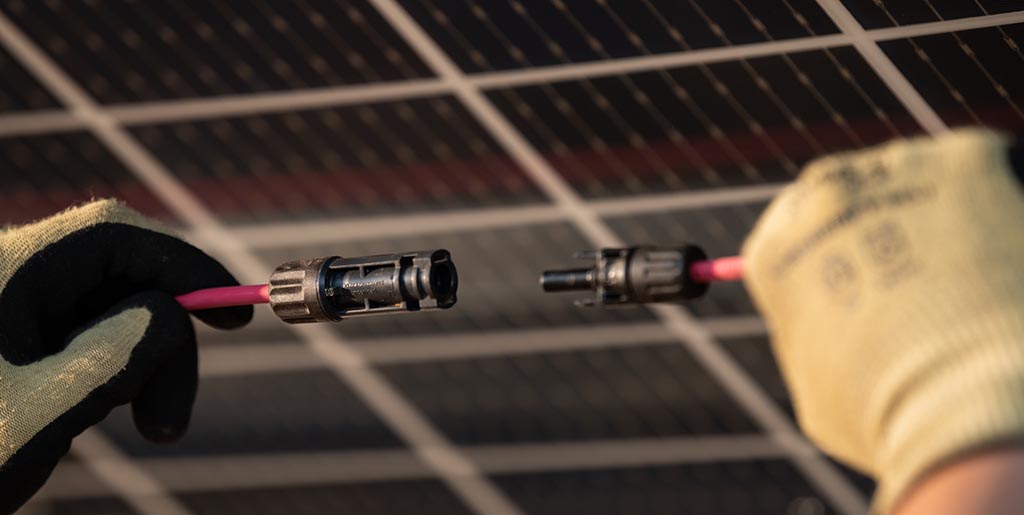
Solar connectors
In large projects, even minor connector issues can create significant delays or energy losses. This underscores the importance of using standardized, high-quality components throughout the system.
Harnesses
Harnesses simplify installation by bundling pre-cut wires and connectors into one assembly.
- They connect module strings to combiners or trunk cables.
- Harnesses can handle single strings or multiple strings.
- Pre-assembled harnesses save labor and reduce installation time.
In practice, harnesses reduce the need for on-site cutting and termination, lowering the risk of field errors. They support plug-and-play installations, accelerating project commissioning.
Combiners
Combiners take the output of several strings and merge them into a single, larger wire. They are a critical consolidation point in system design.
Common features include:
- Fusing: Protects individual inputs from overcurrent and/or backfeed current. Options may vary from standard current fusing protection on the positive inputs, high current fusing on positive inputs, or standard current fusing on both positive and negative inputs.
- Surge Protection Device (SPDs): SPDs offer additional protection from voltage spikes caused by grid disturbances, switching events, and even lightning strikes.
- DC Disconnects: Disconnects allow the input strings of the combiner to be isolated from the rest of the installation for repair or maintenance activities.
Together, these features make combiners essential for safe and efficient power collection in most large-scale systems.
Fuses
Fuses are essential for protecting wiring and components. They prevent damage from overcurrent or reverse current, protecting both equipment and people.
Common fuses are:
- Harness In-line Fuses (output): these fuses are in the cable harness at the output to a trunk bus cable to protect the trunk cable from short circuits or overload conditions.
- Combiner Fuses: these fuses are in the combiner box and offer protection for the input strings on the negative and/or positive leads.
- Harness In-line Fuses (input): these fuses are in the cable harness at the collection point for each string. Their goal is to protect that specific string in the case of overcurrent or backfeed current.
Trunk bus systems
An alternative to traditional combiner boxes, trunk bus systems use a large cable with taps to collect inputs directly.
Benefits include:
- Elimination of separate combiner boxes.
- Reduced trenching, since they are often above ground.
- Easier plug-and-play installation when paired with harnesses.
Because of these benefits, trunk bus systems are gaining traction in utility-scale projects where reducing O&M and installation costs is a priority. EPCs and developers often pair them with DC disconnect boxes for safe maintenance.
DC disconnect boxes
Disconnects help isolate subsections of an installation. They are used with trunk bus systems or with combiners that don’t have built-in disconnects.
Some disconnect boxes also include SPDs or are designed with multiple load break disconnects in one enclosure. This flexibility makes them useful across a wide range of system designs. In addition, they improve safety by giving technicians the ability to shut off sections of the system during service.
Bringing it all together
Every solar installation is more than panels and inverters. Mounting structures, wiring, harnesses, combiners, and disconnects all play a vital role in making projects safe, efficient, and reliable. Together, they create the backbone of solar PV systems that can last for decades.
Understanding these components is essential for everyone in the solar value chain. Whether you are developing projects, managing assets, supplying equipment, or exploring a career in clean energy, knowing how the parts fit together gives you the knowledge to make smarter decisions and avoid costly mistakes.
This post is just the beginning. In Solar Speak 102, we’ll dive deeper into PV systems, exploring advanced design choices, emerging technologies, and strategies to boost long-term performance. Stay tuned for the next installment, where we’ll continue building fluency in the language of solar.
Want to optimize your solar project?
Reach out to Shoals today to learn how our high-quality, factory-tested EBOS, wiring, and other solar solutions can help you build faster, simplify execution, and drive long-term value.


