

Australia’s energy transition is accelerating at the same time the country is trying to build more housing, expand transmission infrastructure, deploy battery storage, and support a new wave of power-intensive data centres. All these sectors depend on one increasingly constrained resource: skilled electrical labor.
The scale of the challenge is significant. The Powering Skills Organisation projects a shortfall of around 17,400 energy-sector workers by 2030 across six critical occupations, with electricians central to that gap. Its workforce analysis also cites Jobs and Skills Australia projections that Australia could need more than 32,000 more electricians across the broader economy as electrification and clean-energy investment expand.
And the energy sector is not competing for those workers in isolation. Housing, infrastructure, mining, manufacturing and increasingly data centres are drawing from many of the same skilled trades. That competition is already showing up in labor costs. In 2026, experienced tradespeople including electricians working on some major tunnelling and data-center projects were reported to be earning around A$300,000-450,000 a year.
For developers and EPCs, the implication is clear: adding workers cannot be the only response. Projects also need to use the electricians already available far more efficiently.
Shoals has been around for three decades, shaping the way solar projects are designed and built today.
Energy and housing are competing for the same skills
Australia’s housing ambitions illustrate the scale of competing demand. The Housing Industry Association estimates the residential building sector needs more than 83,000 additional skilled trades workers to reach the national target of 1.2 million homes between 2025 and 2030. Master Builders Australia has reached an even broader conclusion for the construction sector, estimating that approximately 130,000 additional workers are required beyond normal workforce replacement needs.
At the same time, energy demand for electrical trades is expanding. Powering Skills Organisation research points to strong competition for workers not only from renewable generation, but also from electrification, public infrastructure and construction. Its 2024 Workforce Plan specifically warns that infrastructure demand will compete for occupations critical to the energy transition, including electricians.
This matters because an electrician employed on a housing development, transmission project or data-center build is an electrician who is not simultaneously available to wire utility-scale solar or BESS projects.
Data centres add another competitor for electrical labor
Australia has emerged as one of APAC’s leading data-centre markets, with Sydney and Melbourne established as core hyperscale hubs. This is adding a new layer of strain to an already stretched labour market.
Hyperscale operators are building campuses at unprecedented speed. Individual data-centre buildings can be constructed in roughly 12 to 18 months, creating intense, concentrated demand for specialized electrical trades during the build. As a result, electricians who would traditionally support utility solar or BESS projects are being absorbed into data‑centre construction, further tightening supply.
Workforce studies warn that competition between sectors is now exacerbating shortages, with energy, housing and data centres drawing from the same limited pool of licensed electricians. This is no longer a sector‑specific issue. It is a national engineering constraint.
Training more electricians is essential, but it takes time
Expanding apprenticeships is fundamental to solving the long-term workforce challenge. But it cannot resolve the immediate construction pipeline.
National Centre for Vocational Education Research (NCVER) data show that trade apprenticeship commencements fell 15.3% in the 12 months to June 2025, with decreases recorded across every state and territory except the Northern Territory. More recent figures offer some encouragement: electrician commencements increased 18.2% in the December 2025 quarter, although overall trade commencements were still down 4.2% over the full year.
That is an important distinction. The apprenticeship pipeline may be improving in some areas, but new apprentices cannot immediately fill vacancies on projects that need qualified electrical labor today. Australia therefore needs to address the problem from both directions: grow the skilled workforce and reduce the amount of skilled field labor required per project.
The labor challenge is now an engineering challenge
This is where engineering has an increasingly important role to play. Traditional electrical construction moves a substantial amount of work onto the project site. This includes:
- wiring and terminations
- junction box assembly
- cable routing and segregation
- testing, verification and troubleshooting
- rework caused by weather, dust, or inconsistent workmanship
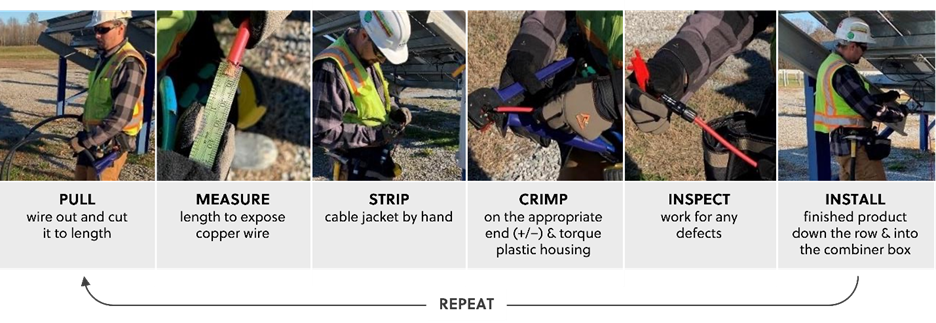
Many of those activities must happen sequentially and under variable field conditions. They also create additional labor touchpoints. When skilled labor is plentiful, that may be manageable. When electricians become one of the limiting resources on a project, the architecture itself begins to affect schedule and cost. That means simplifying electrical architecture, eliminating unnecessary components and connections, standardizing repeatable work, and moving as much assembly and testing as practical into controlled manufacturing environments.
Moving work from the field to the factory
That principle has been at the center of Shoals’ approach to utility-scale solar for decades. Shoals designs and manufactures Electrical Balance of Systems (EBOS) solutions that simplify how power is collected and distributed across large solar projects. Rather than relying on crews to fabricate every electrical connection in the field, Shoals engineers systems so that repeatable work can be completed and tested before equipment arrives at the project.
For example, Shoals’ pre-terminated wiring is measured, cut and terminated in the factory before reaching the site. It arrives ready for installation, reducing field labor and helping eliminate variability associated with site-made terminations. The same philosophy underpins Shoals’ Big Lead Assembly (BLA™), a factory-fabricated, plug-and-play trunk bus solution designed to eliminate field crimping and splicing and simplify DC collection.
The objective is not to eliminate electricians. It is to remove repetitive fabrication work from their workload so skilled crews can focus on the tasks that genuinely require their expertise. And that’s installation oversight, commissioning, testing, compliance, energization and system integrity.
What labor efficiency looks like in practice
The impact can be measurable. In a Shoals installation time study comparing BLA with field-installed insulation piercing connectors (IPCs), BLA installed more than 40% faster across 18 strings. The IPC installations also showed substantially more variation in installation time, while the factory-built BLA process remained comparatively consistent. That distinction matters in a labor-constrained market.
A faster installation does not simply reduce labor cost. It can also:
- allow a finite crew to install more capacity
- reduce schedule variability
- decrease the number of specialized field operations
- reduce opportunities for installation errors and rework
- make labor requirements more predictable during project planning
Shoals’ engineering process also looks upstream. Our teams work with EPCs on field layouts to minimize wire and connector requirements and create simpler systems with fewer potential failure points. That is the larger opportunity: not simply making an individual installation task faster, but engineering labor out of the system before construction begins.
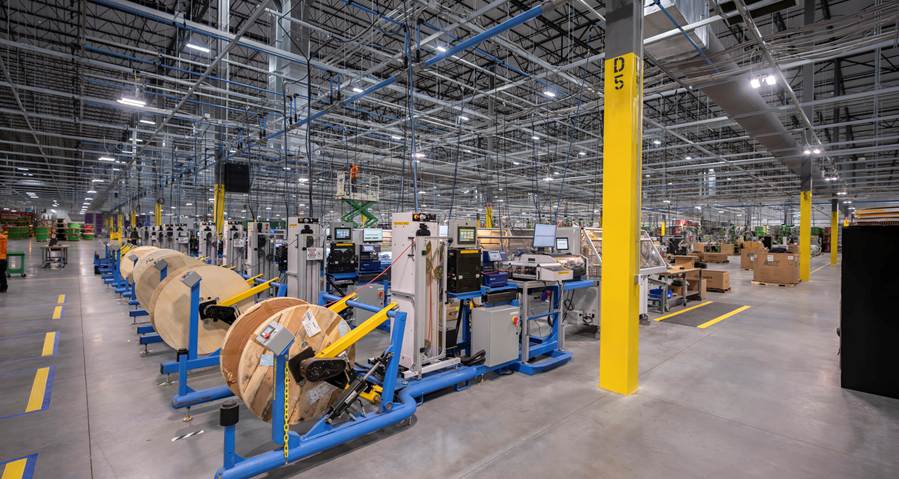
Engineering efficiency must now fill the gap.
Engineering efficiency becomes a capacity strategy
Australia needs more electricians, apprentices, stronger training pathways, and skilled migration. But workforce growth will take time. For solar and storage developers, engineering efficiency offers a more immediate way to build more with the skilled labor available today. That means designing projects to:
- reduce unnecessary connection points
- minimize field fabrication
- standardize repeatable electrical assemblies
- shift assembly and quality control into controlled environments where practical
- optimize cable and component requirements during design
- consider EBOS early
- reserve skilled field labor for the work where it adds the most value
As solar, storage, transmission, housing, and data centers compete for the same workforce, these principles become increasingly important. Engineering efficiency must help fill the gap.
Build more solar and BESS with the labour you have
For 30 years, Shoals has focused on simplifying electrical infrastructure and moving repetitive, labor-intensive work from the field into controlled manufacturing environments. That approach helps owners, developers, EORs, and EPCs reduce field complexity, improve installation predictability, and make better use of scarce skilled labor. Talk to us about simplifying solar and BESS installation through smarter electrical design and factory-fabricated solutions.