Grid constraints and lengthy interconnection timelines are no longer occasional challenges. They have become structural realities shaping how clean energy projects, data centers, and other critical infrastructure are powered. As solar and storage deployments accelerate, and AI demand surges, relying solely on the grid creates risks. Those risks affect project schedules, reliability, and financial performance.
This shift is driving the rapid adoption of Bring Your Own Power (BYOP) or Bring Your Own Generation (BYOG) strategy, where organizations secure dedicated generation and storage assets to power their facilities. On-site and dedicated power resources reduce dependence on constrained grids. They also accelerate timelines and improve control over energy costs and reliability.
The momentum behind this trend is significant. Hyperscalers signed contracts for more than 40 GW of solar power in 2025 alone, and demand for dedicated energy resources continues to grow as organizations seek faster paths to power.
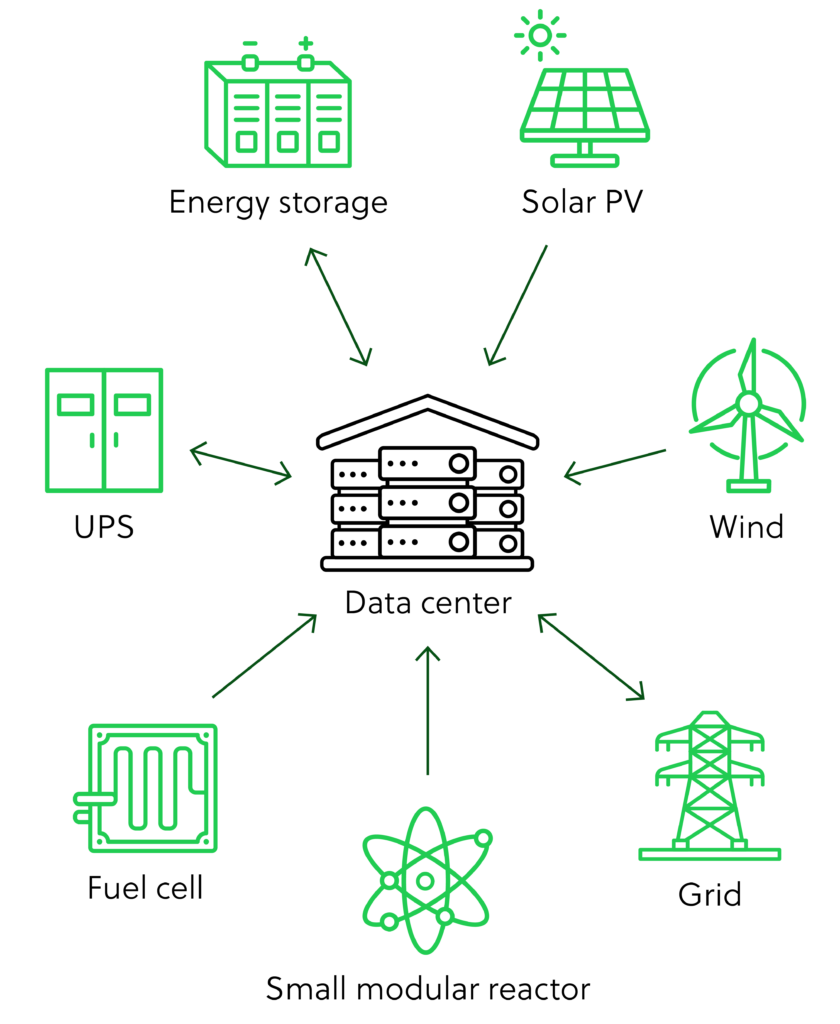
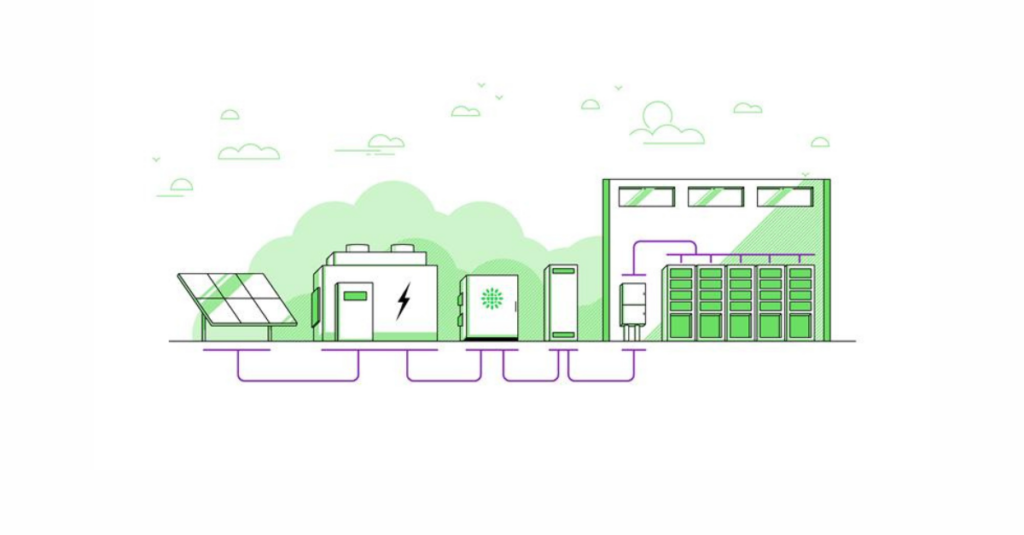
BYOP architecture
Why BYOP Is Becoming Essential
Several converging forces are pushing BYOP into the mainstream.
1. Grid Delays and Capacity Constraints
Traditional interconnection timelines no longer match the pace of modern infrastructure development. According to Lawrence Berkeley National Laboratory’s Queued Up: 2025 Edition, the U.S. interconnection queue contained approximately 10,300 active projects at the end of 2024, representing 1,400 GW of generation and 890 GW of storage capacity.
Despite this growing pipeline, only 13% of projects requesting interconnection between 2000 and 2019 had reached commercial operation by the end of 2024. Meanwhile, the median time from interconnection request to commercial operation has more than doubled from less than two years for projects built before 2008 to more than four years for projects completed between 2018 and 2024.
For organizations operating on aggressive deployment schedules, waiting years for utility capacity is often no longer an option.
2. Explosive Growth in Data Center Demand
The rise of AI is dramatically increasing power demand. S&P Global projects data center electricity demand will increase by 22% in 2025 and nearly triple by 2030.
The U.S. Department of Energy estimates data centers could consume 12% of U.S. electricity by 2028, up from 4.4% in 2023. This growth is placing additional pressure on transmission systems and utility infrastructure already struggling to keep pace.
3. Rising Expectations for Reliability and Resiliency
For mission-critical operations, power is no longer just a utility service—it’s a strategic asset. Even brief disruptions can result in downtime, data loss, operational interruptions, and contractual penalties.
According to AFCOM’s 2026 Trends Report, 65% of data center operators are already using or actively evaluating on-site generation solutions. The statistic reflects a broader industry shift toward taking greater control of power availability and resiliency.
The Power Mix Behind BYOP Architectures
BYOP is not a single technology. Rather, it is an integrated architecture that combines multiple generation and storage resources to meet reliability, cost, sustainability, and deployment objectives.
Common elements include:
- On-site solar PV for daytime generation and reduced grid dependence
- Battery energy storage systems (BESS) for load shifting, peak shaving, and backup power
- Firm generation sources such as natural gas, fuel cells, and emerging technologies that provide continuous availability
- Dedicated off-site renewable resources through direct PPAs or virtual PPAs that support sustainability goals while reducing exposure to grid constraints
BYOP strategies now extend beyond dedicated generation. They also include flexible capacity solutions that maximize existing grid infrastructure. In June 2026, Google and Voltus announced a first-of-its-kind Bring Your Own Capacity (BYOC) agreement that will aggregate up to 100 MW of distributed energy resources—including batteries, smart thermostats, and other flexible assets—into a Google-funded virtual power plant (VPP) within PJM. The initiative highlights a growing trend. Large energy users are combining on-site resources, DERs, and flexibility programs. The goal is to secure capacity and accelerate access to power.
Real-world deployments increasingly reflect this diversified approach. Leading technology companies including Google, Amazon, Microsoft, and Meta have collectively contracted gigawatts of renewable energy in key data center markets. Alphabet’s acquisition of Intersect Power for more than $4 billion and the $1 billion investment by OpenAI and SoftBank in SB Energy further underscore the growing convergence between power infrastructure and digital infrastructure.
Looking ahead, data center leaders expect nearly 30% of facilities to rely primarily on on-site power by 2030. At the same time, 85% report strong interest in behind-the-meter generation solutions.
The Infrastructure Challenge
As more generation and storage move on-site, power infrastructure becomes significantly more complex.
BYOP changes more than the source of power—it changes how power systems must be designed, deployed, and managed. Higher electrical density and dynamic load profiles require infrastructure that can safely aggregate, distribute, and protect power while supporting future expansion.
As a result, project success increasingly depends on solutions that simplify system architecture, reduce installation complexity, and enable reliable operation across a wide range of deployment scenarios.
From solar and storage assets to dedicated power systems serving data centers and industrial facilities, developers need partners with deep expertise in high-voltage DC infrastructure and the ability to deliver solutions tailored to each project’s unique requirements.
Bring Your Own Power Becomes the Default
What began as a workaround for grid delays is rapidly becoming a standard design philosophy.
Instead of waiting for utility capacity, developers are deploying phased power architectures. These combine grid supply, on-site generation, energy storage, and backup resources. These hybrid approaches provide greater flexibility, improve speed to power, and reduce dependence on a single source of electricity.
Grid power remains an essential part of the equation. Most large facilities are not going completely off-grid. However, the traditional model—where utility power alone determines when a project can become operational—is increasingly being replaced by more flexible, diversified approaches.
As Unison Energy CEO Alan Meier recently told Data Center Knowledge, future large-scale data centers will likely require on-site generation. The emerging model combines grid power, on-site generation, storage, and operational flexibility. Dedicated power resources are becoming a core component of modern infrastructure design.
The future of power is not grid versus generation. It is a coordinated blend of both.
Download the Full eBook
Download our eBook, From Solar and Storage to Data Centers: 7 Trends in Power Infrastructure for 2026 to explore the forces shaping energy and power infrastructure.
From AI-driven data center energy demand and grid constraints to the growth of battery energy storage, evolving DC architectures, and faster deployment models, this guide examines the trends defining the next generation of scalable, reliable power systems.
Reach out to our team and take a look at our solutions to learn how Shoals can support your next critical infrastructure project.
From Solar and Storage to Data Centers: 7 Trends in Power Infrastructure
Download our eBook to better understand the forces changing the market and the implications for your projects.