A century after Thomas Edison and Nikola Tesla’s “War of the Currents,” the conversation around how electricity is delivered is resurfacing. Edison championed direct current (DC) as the safer option, while Tesla demonstrated that alternating current (AC) could transmit power efficiently across long distances. AC ultimately became the global standard, dominating electricity networks for more than a century.
Today, the energy landscape looks very different. Solar power, battery storage, electrification, and digital technologies are transforming how energy is produced, stored, and consumed. These shifts are bringing DC back into focus. Solar arrays generate DC, batteries store DC, and electric vehicles and modern electronics operate on DC. At the same time, data centers and AI workloads are driving massive growth in power demand and density. Together, these forces are pushing the industry toward a new chapter where DC architectures play a more central role.
How power is generated and used has changed
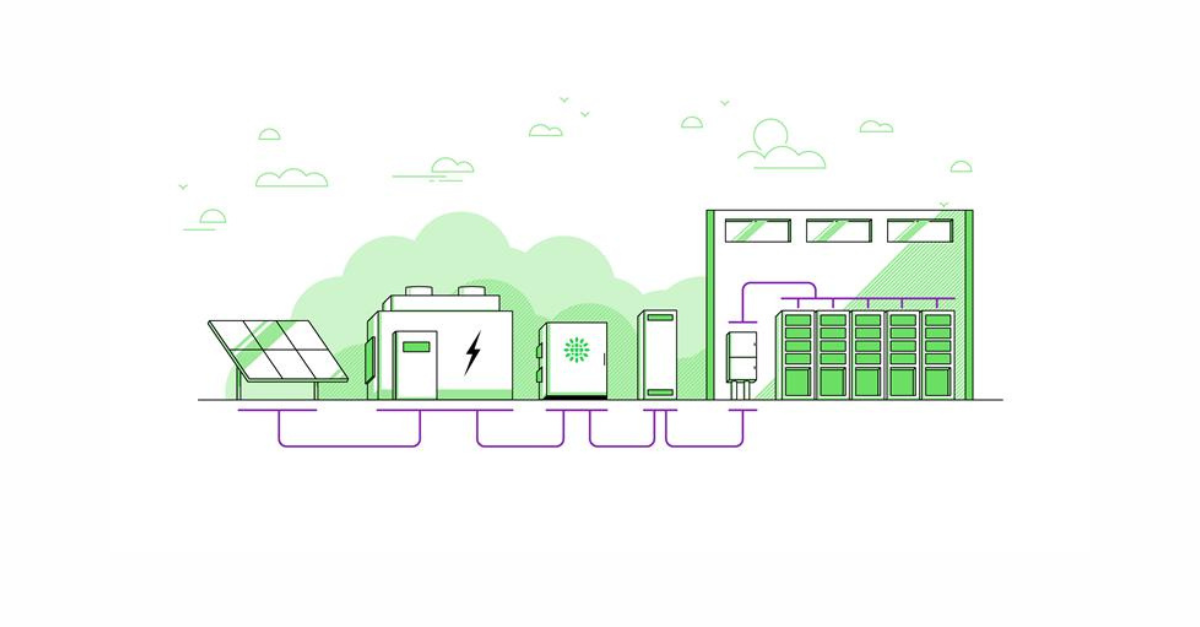
Direct current flows in a single direction and naturally aligns with modern energy technologies such as solar modules, battery systems, and electric vehicles, all of which operate natively on DC. Today’s power systems feature a growing share of DC sources and DC‑centric loads, especially in data centers. As these systems scale, managing power at the site level in DC reduces unnecessary conversion stages and better aligns generation, storage, and consumption, improving overall efficiency.
Alternating current, by contrast, reverses direction many times per second. Its ability to be easily transformed and transmitted over distance made it ideal for early grid development, and it remains foundational to today’s transmission and distribution networks. However, AC‑based architectures often require multiple power‑conversion steps when interfacing with solar, storage, and modern electronic loads, introducing additional complexity, losses, and hardware.
AI-driven infrastructure is accelerating DC load demand at an unprecedented pace. With distributed energy systems and power electronics increasingly dominating both generation and load, the balance between AC and DC is shifting. This is fueling renewed interest in DC architectures across solar, storage, and critical infrastructure.
AC has been considered the global standard for the modern electrical grid, but DC power is increasingly becoming attractive.
Why DC-based architectures are gaining momentum
Several structural trends are accelerating the adoption of DC architectures:
1. Solar + BESS integration
As solar-plus-storage becomes more widespread, reducing conversion losses and maximizing yield become increasingly important. Power conversions introduce inefficiencies that compound over time. System architecture plays a central role in protecting yield over decades of operation.
2. System efficiency and cost control
Every power conversion requires hardware: inverters, transformers, combiner boxes, and AC switches add cost. DC architectures can simplify installation and reduce material usage, helping control project budgets while improving overall efficiency.
The math is simple: where a 480V three-phase AC system typically requires four large conductors, an 800V DC architecture can deliver the same power with only two smaller conductors. This efficiency allows developers to build simpler systems with fewer inverters and fewer points of failure. By avoiding extra conversion steps for DC loads, the power path becomes more streamlined, often reducing cooling demand. This is critical for data centers as power density and heat output continue to rise.
“Developers and data center customers keep telling us they want simpler systems with fewer inverters and fewer failure points. DC architecture gives them that flexibility,”
Cedric Van den Haute
Senior Product Line Manager, New Markets
Shoals Technologies Group
3. Operations and maintenance (O&M) considerations
As projects age, rising O&M costs are driving greater interest in long-term reliability. By reducing connection points and simplifying wiring layouts, DC architectures can help lower failure risk, minimize downtime, and reduce long-term maintenance burden.
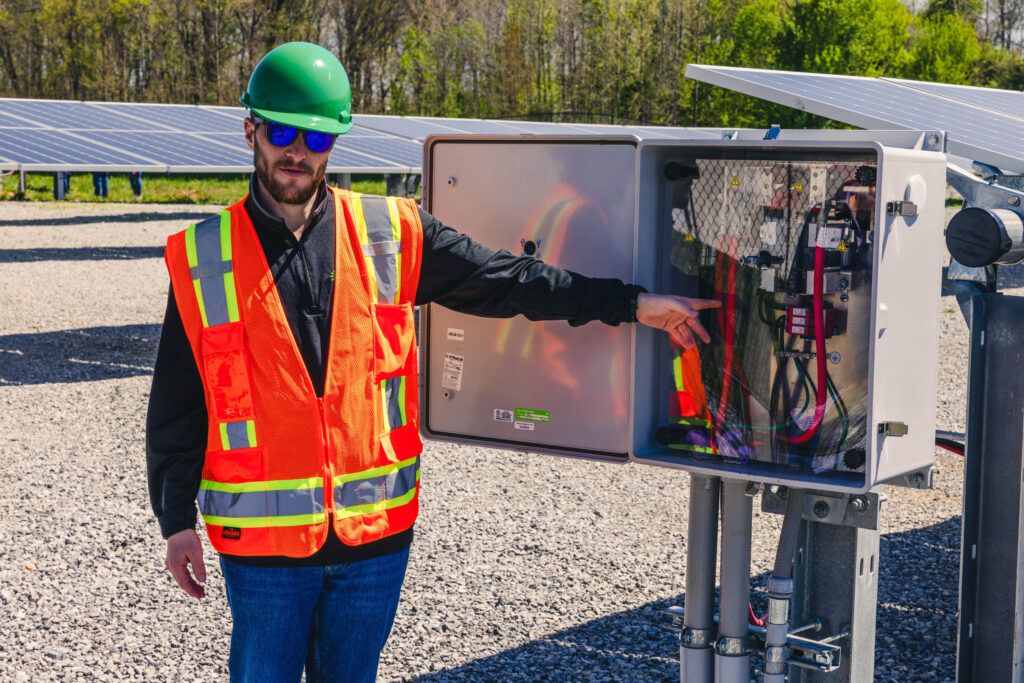
While high-voltage DC systems can introduce challenges, including arc-flash risk, these risks can be effectively managed through proven experience with high-voltage environments such as 1500V DC. With the right design and execution, DC architectures deliver strong safety, reliability, and lifecycle performance.
4. Scale and project growth
Utility-scale solar projects now span hundreds of megawatts, requiring faster builds and more predictable designs. Modular DC architectures support faster builds and more predictable outcomes.
Behind-the-meter solar installations including bring-your-own power approach, are also emerging as a way to add meaningful power on short timelines. This is becoming increasingly important for data center growth, helping projects stay on track as demand accelerates and grid constraints persist.
Shoals is well-known in the industry for high-quality EBOS solutions and deep expertise in solar and storage.
Data center and AI loads
Data centers are driving one of the fastest shifts toward DC power the industry has seen. On the supply side, facilities are increasingly supported by on-site solar, battery storage, and emerging fuel cell deployments. On the demand side, AI server racks and high-density compute systems all depend on large DC loads.
Moves toward higher-voltage DC racks, including NVIDIA’s work on 800-V DC designs, signal where hyperscale data center power architectures are headed. Fewer conversions mean lower losses, reduced cooling requirements, and more usable rack space. DC-based designs can also reduce copper usage by lowering conductor counts, simplifying power distribution inside the facility.
This architecture pairs especially well with DC-coupled BESS systems, where batteries can serve loads directly without unnecessary conversion steps. As compute density and total load continue to rise, DC architectures are emerging as an efficient path to scalable, high-performance data center design.
Experience matters as DC scales
As DC power expands across solar, storage, and data center energy systems, industrial-grade electrical infrastructure becomes increasingly important. Higher voltages and rising power densities place greater emphasis on safety, reliability, and long-term resilience, elevating the importance of design choices made early in a project’s lifecycle.
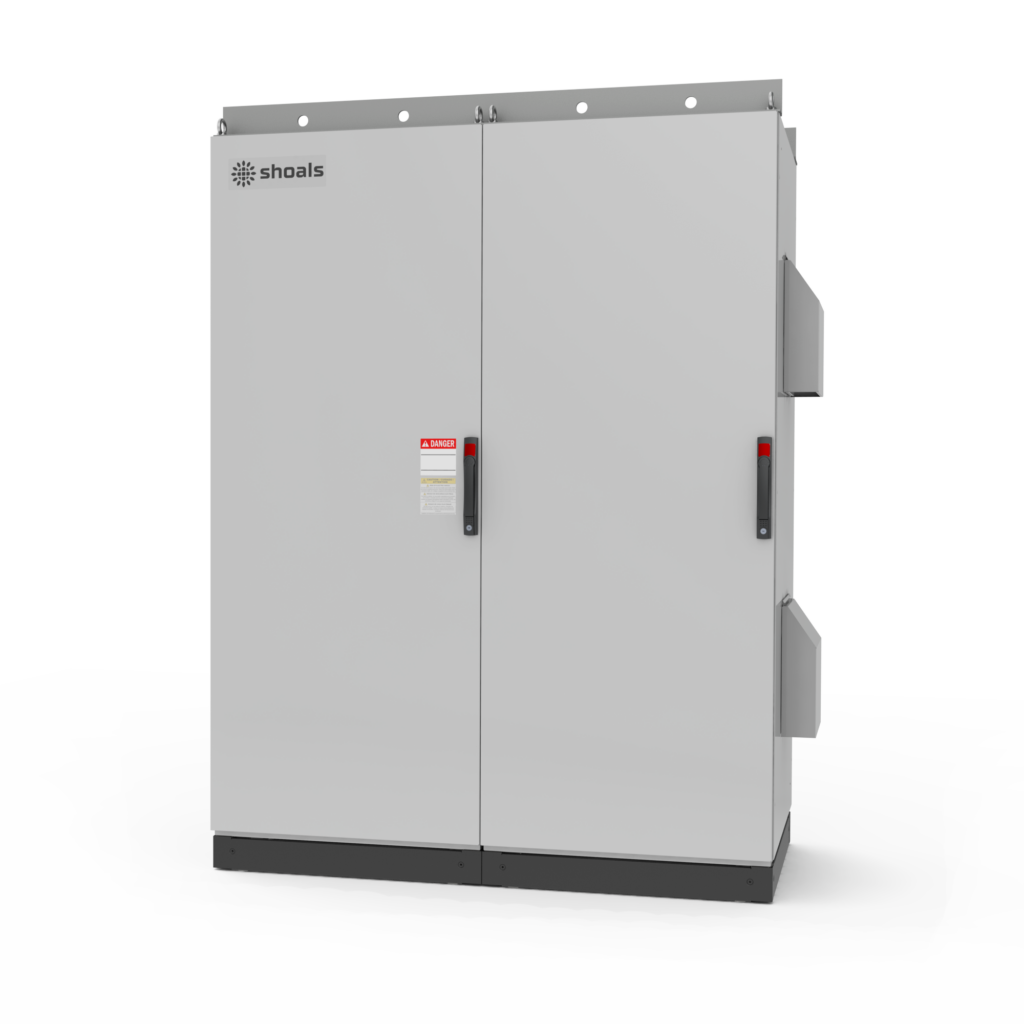
Decades of experience with DC architectures have shaped how Shoals approaches large-scale energy systems, from utility-scale solar and storage to emerging power-intensive applications. That experience informs our solutions designed to simplify installation, reduce labor, and support modular, scalable system designs while prioritizing safety and longevity in the field. Platforms such as the BESS Recombiner reflect how DC architectures can support efficient integration of increasingly complex renewable and storage systems.
Shoals BESS Recombiner
Driven by data centers, storage, and renewables, DC is shifting from a design alternative to a foundational element of energy infrastructure. These architectures are increasingly shaping how power is delivered, managed, and scaled, quietly defining the next generation of resilient, high-performance energy systems.
“We are entering a phase where DC is no longer a niche design choice—it’s becoming essential. As AI, storage, and large-scale renewables grow, DC can deliver the efficiency, density, and scalability these systems demand.”
Cedric Van den Haute
Senior Product Line Manager, New Markets
Shoals Technologies Group
Want to learn more about how the Shoals BESS Recombiner strengthens DC-coupled design?